Accurate data provenance at the record and token level bridges the gap in AI unlearning: how to find the forget set without mass data deletion.
The problem arises at the moment of consent withdrawal by the author. Unlearning algorithms (e.g., NPO or RMU) expect a ready forget set, but in real pipelines, it does not exist. Data is collected from multiple sources, undergoes tokenization and packaging, and the link between the training string and the author is lost. Existing tools capture provenance at the file or dataset level. This leads to over-deletion: too much data is deleted, sometimes the entire corpus. The quality of the forget set directly impacts the result of unlearning, but obtaining it remains a bottleneck.
The solution in OriginBlame is record-level and token-level data provenance. The system does not “guess” authorship but carries it through the entire pipeline. The key choice is deterministic queries instead of post-factum inference. The three-layer architecture (authors ← sections ← document-index) with content addressing (SHA-256) provides verifiability and accuracy. The trade-off is the need for implementation at the dataset construction stage: it is not possible to retrospectively restore provenance. However, this eliminates dependence on access to the model and gradients when searching for the forget set.
In implementation, minimal invasiveness is crucial. Integration boils down to a single track() call per record. Metadata is stored in .ob/ as JSONL without a central database. Sharding by hash prefix provides O(1) access to buckets. Writing occurs through process-isolated files and a WAL-like pattern, followed by merging. Queries come in two types: direct (blame) and reverse (show). The “lazy cascading revocation” model only changes the flag for the author or section; all consequences are computed on read. This makes revocation cheap and reversible. A separate token-index layer addresses the issue of identity loss after tokenization: instead of per-token records, a range is stored through cumulative token_count, which reduces overhead and maintains traceability to authors.
Results show that granularity is critical. On 219,555 pages of Wikipedia, the transition from dataset-level to record-level reduces over-deletion from up to 101× to ~1.3× depending on the author’s contribution share. This is expected: in collaborative authorship, the file is not divided by authors, and only the string becomes the minimal unit of deletion. Overhead is moderate: integration results in a ~1.3–4.0% drop in throughput in HuggingFace and 2.1–19.0% in Datatrove on the same data. Storage grows to ~1.23–1.33× due to metadata. Recovery of links after data mutations (reconcile) reaches 96–98% thanks to a two-phase scheme: exact hash matching and semantic matching via embedding.
At the downstream level, an accurate forget set impacts the quality of unlearning. For the 1.7B parameter model, with equal sample size, provenance-based sets improve forgetting and utility retention metrics compared to a random baseline. For NPO, there is up to a 42% improvement in the forget PPL metric while simultaneously achieving better retain PPL. The causal relationship is direct: the more accurately we localize the contribution of unwanted data, the less collateral damage to the rest of the distribution.
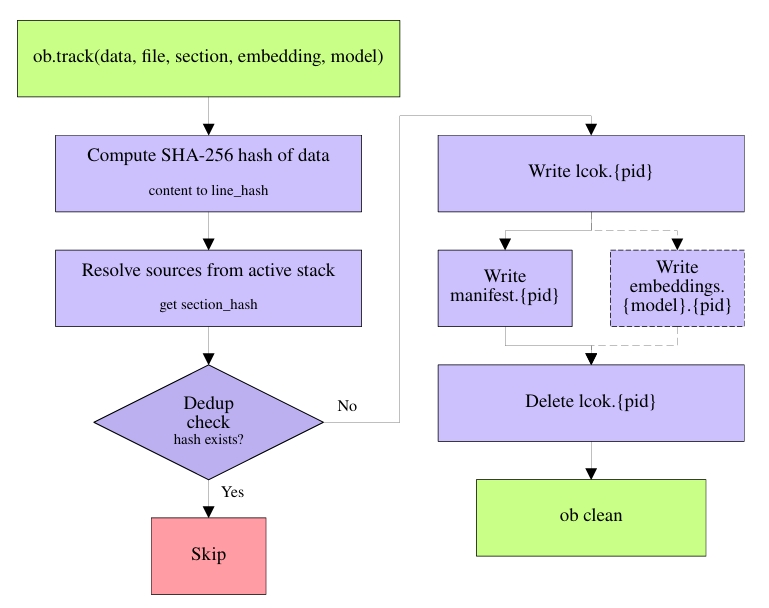
Figure: The track() workflow. After hash computation, the system checks for duplicates and writes to process isolated temporary files under WAL protection.
There are also limitations. The approach requires early integration into the pipeline. The ecosystem of parsers is still limited. Provenance is one-step: intermediate transformations are not tracked. The index speeds up queries, but the gain is not always significant with parallel scanning. A separate risk is working with PII: the authors layer stores email and name, so in production, it is necessary to separate identifiers and protect access to queries.
The conclusion is pragmatic. Record-level and token-level data provenance is not an “accelerator,” but a necessary condition for correct unlearning. OriginBlame bridges the gap between “who to forget” and “which data to forget” through deterministic tracing across the entire pipeline and provides manageable trade-offs in performance and integration complexity.
Information source
arXiv is the largest open preprint repository (since 1991, under the auspices of Cornell), where researchers quickly post working versions of papers; the materials are publicly accessible but do not undergo full peer review, so results should be considered preliminary and, where possible, checked against updated versions or peer‑reviewed journals. arxiv.org