MEV in DAG BFT manifests even with “honest” parallel block generation. An analysis of Mysticeti shows where exactly the ordering bias arises and why this is important for SRE and architects.
In DAG-based BFT protocols like Mysticeti, parallel block proposals are expected to eliminate centralized influence on transaction ordering. In practice, degradation begins at the moment of linearization of the DAG into a final order. This is where the system transitions from a partial order to a total one, and any detail of tie-break logic becomes critical. In Mysticeti, blocks from the same round are sorted by validator index. This creates a consistent advantage for validators with a lower index. In an experiment on a network of 13 validators, such nodes receive priority approximately 89% of the time without any malicious behavior. This is not a failure, but a consequence of a deterministic rule.
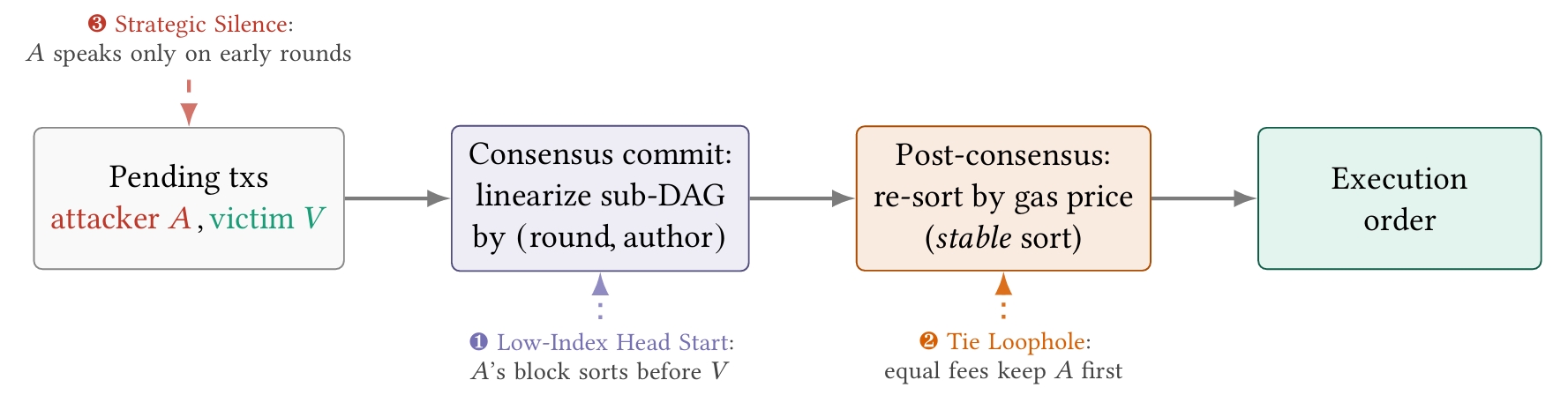
Fig. 1
How a transaction’s final order is decided on Sui, and where the bias enters. 1) Consensus produces a total order from the
committed sub-DAG by(round, author); 2) thenastable gas-price re-sort runs on top; 3) avalidator can further tilt step 1 by choosing
when to stay silent. All three are legitimate protocol behaviors.
Attempting to compensate for this through re-sorting by gas price appears pragmatic but turns out to be a compromise solution. The re-sorting is implemented as a stable sort, which preserves the original order in the case of equal fees. Since most transactions use a reference gas price, fee equality is a common occurrence. As a result, the bias from consensus directly passes into the execution layer without additional cost to the attacker. This turns MEV into a “free” opportunity. Thus, protection only works with explicit overpayment, which alters the economics of the system but does not eliminate the root problem.
The implementation amplifies the effect through permissible validator behavior. In Mysticeti, a validator can refrain from publishing blocks in certain rounds without violating the protocol. This opens up a “strategic silence” strategy: a node publishes blocks only in early rounds, where the likelihood of being at the front of the order is higher. In short time windows (around a second), this increases the likelihood of winning in order to more than 94%. The reason lies not in the sorting algorithm but in the causality of the DAG: early rounds are always prioritized. This is an important trade-off between liveness and control of node behavior. Banning “silence” is difficult without degrading fault tolerance.
From an engineering perspective, it is important that consensus is not broken in this process. Safety and liveness are maintained below the Byzantine threshold. The problem is localized in the order finalization mechanism, not in achieving consensus. This is a typical case where the system is formally correct but economically vulnerable. In the industry, such effects are already discussed as an order-fairness problem, where it is impossible to achieve perfect fairness due to discrepancies in the observed order of events.
The proposed fix is minimalist and illustrative. Instead of a fixed tie-break by index, a pseudo-random key dependent on the commit state (e.g., the hash of the leader and block) is used. This maintains determinism but removes the predictable advantage. In measurements, this reduces the same-round bias from ~89% to ~45%, which is close to the “fair” boundary. A similar approach is applied to sorting by gas price, eliminating the tie loophole. However, strategic silence remains, as it is related to the order of rounds rather than the tie-break.
The key takeaway: in DAG-based systems, fairness is determined not by the architecture of the DAG itself but by the specific linearization function. This is a layer that is often perceived as a “technical detail” but actually controls the economics of the system. For architects, this means that any deterministic tie-break rules should be considered a potential source of MEV, even if the rest of the system appears distributed and balanced.
Information source
arXiv is the largest open preprint repository (since 1991, under the auspices of Cornell), where researchers quickly post working versions of papers; the materials are publicly accessible but do not undergo full peer review, so results should be considered preliminary and, where possible, checked against updated versions or peer‑reviewed journals. arxiv.org